Franklin

Franklin

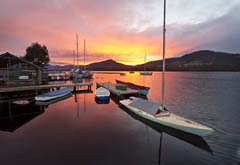
Franklin is a beautiful little town on the banks of the Huon River in Tasmania. On Thursday the weather bureau forecast fog for the Huon District, so I got up at 5:30am to get some misty shots. No sign of fog anywhere and the sky was overcast, so after an hour I turned the car around for home, wishing I’d stayed in bed. Heading back through Franklin there was a touch of colour in the east, so I stopped and waited. And then it happened – 5 minutes of wonderful light. YES!

Be There


The Number 1 Rule of Landscape PhotographyNine good friends from my camera club went up to Cradle Mountain for two nights a few weeks ago. The idea was to capture the brilliant turning of the fagus (deciduous Beech, Nothofagus gunnii) which occurs in Tasmania’s sub-alpine areas around the end of April.Phil and I arrived just after lunchtime on Friday and were able to get to Crater Lake to see it in all its glory. Saturday was terrible – heavy rain all day and we all got very wet doing the Dove Lake Circuit. The highlight was visiting the Wilderness Gallery at the Cradle Mountain Chateau where there is some inspirational photography from masters of their craft.

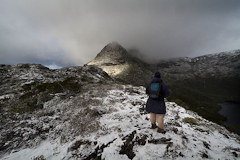
And now to the point of the story. My idea to get up at 5am on Sunday and walk up to the Twisted Lakes for sunrise didn’t get a great reception. But Phil joined me and we struggled up by torchlight in the bitterly cold morning. Not long after starting, Phil’s cries alerted me to head back – he had simply fallen off the track and was 5 metres below doing a turtle impersonation, lying helplessly flat on his back on his pack. Still we struggled up, wondering what we were doing there. We reached Twisted Lakes about ½ hour before dawn and waited – and waited – and waited, getting colder and colder. No dawn! Defeated, we headed back down, wishing we’d stayed in our sleeping bags.

And then it happened. Nature put on a light show, periodically lighting up Little Horn as the clouds scudded past. Pure magic, we arrived back elated.

So what is the number 1 rule of landscape photography?

BE THERE! Without it, all other techniques fail.

Fagus

Fagus

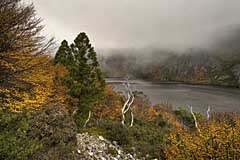
In late April and early May, Australia’s only native deciduous tree Nothofagus gunnii changes colour in a brilliant display in Tasmania’s sub-alpine highlands. The common name is Deciduous Beech, but most Tasmanians know it as fagus and the ”turning of the fagus” is an much-anticipated event in Tasmania.The bush is found only in Tasmania and commonly grows to about 2 metres high, forming an almost inpenetrable tangle around lakes and waterways, hence its other common name “tanglefoot”.

The fagus plants lose their leaves in response to the cold, dark winters in the highlands. As the plants shut down, the leaves lose their chlorophyll, change colour to brilliant yellows, oranges and reds and eventually fall to the ground.

The best places to see the brilliant colour display are at Mt Field and around Cradle Mountain. At Mt Field the Tarn Shelf is an annual pilgrimage for many on ANZAC Day, while the best place to see it at Cradle Mountain is around Crater Lake.

Fagus at Crater Lake

Fagus at Crater Lake

 Do you want to see more of Mike’s stunning photography? Click here now…


Tasmanian Devil Facts and Pictures

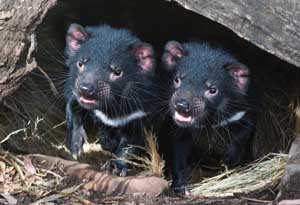
Tasmanian DevilTasmanian Devils are unlike any other animal in the world. Although only the size of a small dog, their horrendous screeches led early Tasmanian settlers to name them Devils. Up until maybe 400 years ago they were widespread throughout Australia, but now they can only be found only in Tasmania. It is thought that competition from dingoes led to their extinction on the mainland.

Tasmanian DevilLike many of Tasmania’s native animals, devils are marsupials. This means that they are born very immature and develop in their mother’s pouch. The mother gives birth to 20 – 40 young, each about the size of a grain of rice. She has only four teats, so the first four to get to her pouch have any chance of survival. There they stay for the next four months until the mother leaves them in a den, returning frequently to suckle them and teach them how to find food. They become independent at nine months of age and mature at about two years old, living for five or six years in the wild.

Devils are carnivores. Although they hunt small prey such as bettongs, birds, fish and reptiles, they eat carrion more often than not. They have extremely powerful jaws and will devour an entire animal in a sitting – meat, fur and bones, leaving nothing.

The early European settlers believed that devils were a threat to their livestock, so in 1830 a bounty was placed for every devil killed. They almost became extinct, but were saved in 1941 when a law was passed protecting them. They are now in danger again from the Devil Facial Tumour Disease which is spreading rapidly throughout the population. Scientists are currently working very hard to save them from extinction.

The Tasmanian Devil is an iconic Tasmanian animal. It is the symbol of the National Parks and Wildlife Service, as well as numerous Tasmanian sporting teams. Many tourist attractions and products feature devils. It would be a tragedy to lose them. To find out how you can help, check out the Save the Tasmanian Devil Appeal on the web.

Mike offers some fantastic, low cost products featuring his stunning Tasmanian photography. You can find them here:

Tasmanian Photography - Landscape Photography and Tasmanian Wildlife

Tasmanian E Books (Electronic Books) - Tasmanian Photo Book and Children’s Books

Enjoy!